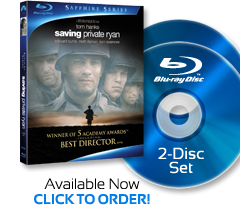
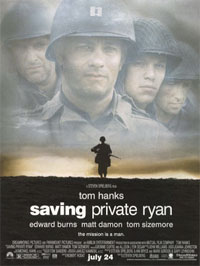
Saving Private Ryan
World War II was a pivotal event of the 20th century and a defining moment for America and the world. It shifted the borders of the globe. It forever changed those who lived through it, and shaped generations to come. It has been called "the last great war."
June 6, 1944. D-Day. Nothing could have prepared the soldiers at Omaha Beach for the battle they are about to wage. Filled with hope and resolve, none of them knows if they will survive the small strip of beach ahead of them. As his eyes scan the Normandy coast, Captain John Miller (TOM HANKS) believes that getting himself and his men past the gauntlet is the greatest challenge he has faced in the war. But his hardest task still lies ahead.
Even as the Allied forces begin to get a foothold at Omaha, Miller is ordered to take his squad behind enemy lines on a dangerous mission to find and retrieve one man: Private James Ryan (MATT DAMON). The youngest of four brothers, Ryan is the last survivor, the other three having all been killed in action within days of one another.
As the squad pushes deeper into enemy territory, Captain Miller's men find themselves questioning their orders. Why is one man worth risking eight--why is the life of this private worth more than their own?
Planning and Recruitment
"How do you find decency in the hell of warfare?" asks director Steven Spielberg. "That was the paradox that first attracted me to the project."
Screenwriter Robert Rodat agrees. "The film is about decency, and how patriotism ultimately has to do with one's responsibility to family, to neighbors and to those one fights alongside in the military."
Two events, coinciding four years ago, inspired the screenplay for "Saving Private Ryan": the 50th Anniversary of D-Day and the birth of Rodat's second son. He recalls, "A number of books were published to commemorate D-Day, and I was reading them when my son was born. I live for much of the year in a small New Hampshire town, and I would take my new son for walks in the early morning hours. In the town square, there's a monument to those from the village who died in war, dating back to the American Revolution. In almost every war, there were repeated last names--brothers who were killed in action. The thought of losing a son to war is painful beyond description; the thought of losing more than one is inconceivable."
Rodat brought the initial story concept to producer Mark Gordon, who remembers, "When Robert pitched me the idea, I instantly responded to it. It had the elements of a powerful human drama within an exciting action tale."
Over the next year, Rodat developed the screenplay with Gordon and his Mutual Film Company producing partner Gary Levinsohn. They then got it to the actor they had always envisioned in the lead role: Tom Hanks. "We were thrilled when he expressed an interest in the project," Levinsohn says.
"I've always been fascinated by World War II," Hanks reveals, "and I'm perpetually searching out books and other material that depicts the war as a human experience as opposed to a tactical one. That was a very vivid thing that came through in "Saving Private Ryan": on the one hand, it is a grand adventure story, but it is also a very human story."
Coincidentally, the screenplay had also been given to Steven Spielberg, whose own fascination with the era in which the story is set has been evident in many of his films. "Nearly half the films I've directed take place in the '30s and '40s," he acknowledges. "In fact, when I was barely a teenager, the second or third movie I ever made was a World War II action adventure called "Escape to Nowhere." I also grew up watching war movies, which had a tremendous influence on me."
Though the closest of friends, Hanks and Spielberg had never collaborated on a film before. The director allows that they shared some concern about working together, though it proved unwarranted. "I was thrilled that we were able to do this movie together," Spielberg says. "I've always had tremendous respect for Tom, and this experience enhanced my respect for him, both as an actor and as a human being. He offered great suggestions that benefited the film and was completely open to my ideas about his character. It was wonderful."
Hanks stars as Captain John Miller, the enigmatic officer who is chosen to lead a squad of young GIs on the perilous mission to find Private Ryan. "You're not really supposed to know anything about him," Hanks states. "You know he's a Captain, but beyond that, even his own men don't know where he's from, what he does for a living, what his motivations are? I think, as an officer, you have to remain cognizant of the fact that you're sending guys off to be killed, and that takes a kind of self-defense mechanism. It was one of the great attractions of the role; I don't often get to play men of mystery."
Spielberg adds, "One of the themes of the story is who is Miller...and who was he" Without flashing back or using any "tricks," can we see another side to him? It was very challenging in that regard."
Captain Miller is even something of an enigma to the man who has fought by his side for years, Sergeant Horvath, known simply as Sarge. Tom Sizemore who plays the veteran soldier, notes, "Sarge might know more about Miller than the other guys, but he doesn't know a lot either. Regardless, he is "by-the-book"; his first priority is to take care of his Captain, to protect him and make sure that he gets out alive."
If Sergeant Horvath is Miller's "right arm," then the thorn in his side is Private Reiben, a wisecracking New Yorker who makes no secret of his resentment about risking his life to save one private. A rising filmmaker in his own right, Edward Burns won the role after Spielberg caught his performance in Burns' award-winning debut film. Spielberg says, "I saw "The Brothers McMullen," and immediately saw Eddie as Reiben. He has that dry Brooklyn quality, and knows how to get a laugh without milking it."
"When I read the part of Reiben, I thought, 'this is a guy I can really have some fun with,'" Burns comments, but he is quick to clarify that the term "fun" must be taken in context. "These guys see so much horror that they have to mask some of their pain through dark humor. I think Reiben is trying his best to make light of the horrific things he witnesses. So, when I say "fun," I mean it's an interesting opportunity for me as an actor to portray these kinds of emotions."
To play the other soldiers in the squad, the filmmakers brought together an ensemble of young actors. Vin Diesel is Private Caparzo, a tough New York Italian with a gentle side; Giovanni Ribisi plays Wade, the squad?s dedicated medic; Barry Pepper is Private Jackson, a Bible-quoting Tennessee sharpshooter, whose dead aim proves to be a godsend; and Adam Goldberg plays Private Mellish, a Jewish kid from Yonkers, who knows he has more at stake in fighting the Nazis.
The one outsider joining the group is Corporal Upham, a bookish young man who finds himself "drafted" into Captain Miller's squad when their interpreter is killed on D-Day. Jeremy Davies plays the "fish-out-of-water," who Spielberg says serves an important purpose in the drama. "Upham's never been under fire, never seen the panic and chaos of battle first-hand, so I think he represents the audience. Through Upham, they get to come along for the ride, following Miller and his men into war."
"Not having even an inkling that he might get close to combat and then being thrown in the thick of it--that, more than anything, defines him," Davies adds. "It's quite a journey for him, and he goes through quite an evolution."
On the heels of his Oscar-nominated performance in "Good Will Hunting," Matt Damon portrays the object of their mission: Private James Ryan. "Ryan becomes a symbol for Miller and his men, because his going home would represent all of them going home," Damon offers.
Arriving on the set after the other members of the cast had already spent weeks together was, for Damon, much like Ryan's finally meeting up with Miller's squad. "None of us knew what to make of each other at first, which was perfect for the story," Damon recalls, noting that it was Spielberg who ultimately broke the ice. "It's amazing to work with him; you just feel lucky to be there. He knows exactly what he wants, and when he gets it, it's a great feeling for everyone. It draws you in and makes you part of the team."
Unlike the actors playing Miller's squad, the part of Private Ryan did not require Damon to endure military-style basic training. "I would have liked to have done it," he says. "Liked" might not be the word his castmates would have chosen.
Boot Camp
To transform their acting ensemble into a credible military unit, the filmmakers enlisted the aid of former U.S. Marine Corps Captain Dale Dye, whose dedication to the military did not end with his retirement from the service.
"I believe there is a certain core spirit that is common among men and women who fight for their country, and I think to understand it fully, the actors playing them need to experience the rigors that combat people all over the world face," Dye states. "So, to the extent I can, I immerse the actors in that lifestyle: I take them to the field; I make them eat rations; I make them crawl and sleep in the mud and the cold and the dirt... And when they come out, if I've done my job successfully, they have an inkling of what people sacrifice to serve their country in the military."
Dye and the staff from his company, Warriors Inc., took Tom Hanks, Tom Sizemore, Edward Burns, Jeremy Davies, Vin Diesel, Barry Pepper, Giovanni Ribisi and Adam Goldberg through what amounted to nothing less than boot camp. From the start, he kept them constantly reminded of the job at hand, calling them only by their character names and drilling into them the basics of soldiering. They had a total of ten days of training, including weapons drills, close combat, individual maneuvers and tactics, and World War II-era military lingo and hand signals.
"By the end, we were proficient in drills and infantry movements, so we really felt like the genuine article," Diesel states. "We also knew how to handle a weapon--I was able to disassemble and reassemble an M1 rifle blindfolded to simulate having to do it in darkness."
The last five days of boot camp--spent in the field, living in tents and eating rations--proved a test of their spirits as well as their endurance. The actors had to suspect that Dye could even command the elements when, on their first day out, a cold rain turned the ground to muck.
Goldberg jokes, "If you could imagine Stanislavski running boot camp, that's what it was like. We were forced to be "method," whether we wanted to or not. The only way I could get through it was to shut myself down and become this soldier. But, in the end, it proved beneficial to all of us."
"Essentially, we were trying to get our heads into the mindset of an infantryman, but the experience of actually being there was indescribable," Ribisi affirms. "We were soaking wet, hiking five miles a day with 40 pounds of gear on our backs, getting about three hours of sleep...only you don't really sleep because you're freezing and shaking in a tent. Afterwards, I had a huge sense of accomplishment."
"I didn't want to do it," Sizemore admits. "The way I looked at it, just because I had to act like a soldier, why did I have to be a soldier? But something happened to us out there. We learned that you don't do anything by yourself in the military; it really is teamwork. If another guy is having a hard time--he can't get his gear on, he's sick, whatever--you stop and help him out. It brought us closer together, so when we started shooting the movie, we felt a bond."
Hanks adds, "We were playing soldiers who were tired and miserable and wanted to go home, and I don't think we could have done that justice without having experienced what Dale Dye put us through. I think he was trying to instill in us the idea that when you think you can't go any farther, you can. You just have to decide to do it, which is exactly the situation in which many of the men involved in the Normandy invasion found themselves."
Battle Plans
The re-creation of the massive D-Day landing at Omaha Beach was, perhaps, the most formidable challenge facing Spielberg and company.
The first order of business was to find a suitable location. The beach where the original event took place is not only a protected historical landmark, but had become far too developed over the years. After weeks of research, production designer Tom Sanders accompanied the location scouts to a variety of beaches in France, England and Ireland. It was in Ireland that they found a perfect stretch of coastline that was uncannily similar to Normandy, from the golden color of the sand to the line of windswept cliffs set back from the shore.
Sanders and his team then transformed the Irish coast into the German stronghold at Normandy, complete with the defensive Belgian gates and iron hedgehogs. On the beach, they built a "shingle," a low seawall of rocks and sand topped with barbed wire. They also dotted the cliffs with pillboxes, the mini-forts from which the Germans rained down a relentless barrage of gunfire.
One of producer Ian Bryce's more difficult tasks was tracking down any World War II-era landing craft--called Higgins boats--still in existence. "Tanks and other vehicles are quite plentiful, but we had to look all over the world for the landing craft. Some were discovered in England and a couple in Scotland, but interestingly enough, we found the majority of them in Palm Springs, California," Bryce recalls. The landing craft were then shipped to England and refurbished for the invasion sequence.
An invasion calls for a sizable number of armed forces, and when you need armed forces, the best place to turn is the military. The Irish army provided 750 extras for the D-Day scene, many of whom were movie veterans, having worked on Mel Gibson's "Braveheart."
Feeding and costuming so many extras might have been a logistical nightmare were it not for a system dubbed "the sausage machine," originally perfected by associate producer Kevin De La Noy when he also worked on "Braveheart." The extras were broken down into 15 groups of 50, which were fed, clothed and made up in varying order. At the end of the day, each group went back through the system in reverse. It worked like a proverbial well-oiled machine.
Virtually none of the uniforms from World War II are still in existence today, so costume designer Joanna Johnston had to have more than 3,000 authentic uniforms of the day made from scratch to outfit all the principals, as well as the many extras. Johnston also located the company that made the original American troops? boots and had 2,000 pairs of boots made using the same pattern. Then, all the uniforms and boots had to be put through an aging process to make them appear battle-worn.
Though the military style of the film didn't allow her much creative leeway, Johnston found ways to reflect specific traits of the main characters in their uniforms. Captain Miller's guardedness, for example, is seen in his assault vest and his helmet pulled low, shadowing his eyes. Reiben's uniform is the scruffiest because he likes to break the rules and go against the grain, while Jackson's uniform epitomizes a warrior with his ammunition always at the ready. Having seen no combat, Upham starts out very pristine and slowly takes on a battle-worn appearance.
Donning the uniforms had a profound effect on the main cast, arriving on the set only days out of boot camp. Diesel remembers, "All the research we had done could not have prepared us for the feeling that you got when you had the uniform on. Standing on that expanse of beach with the Higgins boats in the water...it was breathtaking. It was only then that I could start to appreciate what the soldiers in World War II felt like at Omaha Beach."
In any war movie, guns are an integral accoutrement to the soldiers' uniforms. It took armorer Simon Atherton three months to gather or create the 2,000 weapons necessary for the production. Atherton and his team were also responsible for daily inspections of every gun for sand and debris which could create obstructions in the barrels and make them unsafe.
Safety was a primary concern to Spielberg and his entire production team. With that in mind, special effects supervisor Neil Corbould worked closely with the director and with stunt coordinator Simon Crane to establish the exact placement of the actors and stunt people with regard to the rigged explosions. They spent weeks testing explosives and then rehearsing with people to ensure everyone's protection. "Steven is very safety conscious," Corbould notes. "He encouraged me or Simon to tell him when we felt something was not safe, and was quite happy to alter the shot or do whatever it took to make it safe."
Combat Footage
Contributing to the heightened sense of realism, Spielberg took an almost documentarian approach to filming "Saving Private Ryan." He did not do any storyboarding prior to shooting, and used hand-held cameras much of the time. "In that way, I was able to hit the sets much like a newsreel cameraman following soldiers into war," he offers.
To achieve a tone and quality that was not only true to the story, but reflected the period in which it is set, Spielberg once again collaborated with cinematographer Janusz Kaminski. "Early on, we both knew that we did not want this to look like a technicolor extravaganza about World War II, but more like color newsreel footage from the 1940s, which is very desaturated and low-tech," Spielberg says.
Kaminski had the protective coating stripped from the camera lenses, making them closer to those used in the '40s. "Without the protective coating, the light goes in and starts bouncing around, which makes it slightly more diffused and a bit softer without being out of focus," he explains. The cinematographer completed the overall effect by putting the negative through an additional process that extracted more of the color.
Another camera technique they applied was using 90-degree shutters, or even 45-degree shutters for many of the battle sequences, as opposed to today's standard of 180-degree shutters. Kaminski clarifies, "In this way, we attained a certain staccato in the actors' movements and a certain crispness in the explosions, which makes them slightly more realistic."
Spielberg was unflinching in his desire to depict the Omaha landing as it really happened. "Omaha Beach was a slaughter," the director recounts. "It was a complete foul-up: from the expeditionary forces, to the reconnaissance forces, to the saturation bombing that missed most of its primary targets. Given that, I didn't want to glamorize what had really happened, so I tried to be as brutally honest as I could."
After all the planning, preparations and rehearsals, the attention to authenticity down to the last detail worked its own magic. When Spielberg called "Action," the cast could not help but feel transported from a movie set to an event half a century past.
"The adrenaline rush was like nothing I had ever experienced on any other movie, because it was chaos as soon as you stepped out there," Tom Hanks remembers. "There were people falling and explosions going off around you, and it was not hard to imagine that the carnage was real, that it was caused by bullets and mortars and shells. There's terror in our eyes in some of those scenes, and rightly so, because we were genuinely scared...and we knew that it was all fake."
Edward Burns adds, "I'm really glad we shot the D-Day invasion at the beginning of the schedule because it changed the way we looked at every scene that followed it. Nobody was prepared for how horrific it really was, and you really got a sense of what those guys went through."
"Being out there that day on the Irish Sea in those boats gave me a sensation of what it must have been like for those men," says Barry Pepper. "My mind started to wander and I began to think about how afraid they must have been. They were so tired and soaking wet, and then they stepped off the boats and saw their pals dying all around them, and all they could do was crawl up those beaches."
"The miracle of D-Day was that in the chaos of the invasion, with the generals far away and most of the plans having gone awry, small groups of privates and non-coms and mid-level officers took the initiative and, at terrible personal risk, did what needed to be done," screenwriter Robert Rodat offers.
Noted historian and author Stephen E. Ambrose, who has written what many consider to be one of the definitive books on D-Day--D-Day: June 6, 1944: The Climactic Battle of World War II--is serving as a historical consultant on "Saving Private Ryan." He observes, "The film catches what happened exactly. It is, without question, the most accurate and realistic depiction of war on screen that I have ever seen, not only in terms of the action, but the actors look, act, talk, walk, bitch, argue and love one another exactly as the GIs did in 1944."
Leaving Ireland, the company relocated to England for the remainder of principal photography. The abandoned British Aerospace facility in Hatfield, Hertfordshire, some 45 minutes north of London, served as the production's English base camp. The buildings on the site provided offices and workshop space, and the grass fields became a perfect backlot. There, Tom Sanders and his team built a full-scale reproduction of a bombed-out French village, complete with a bridge spanning a river where the story reaches its climax for Miller and his men.
Working literally from the ground down, they began by digging an actual river, and then constructed a war-torn French town around it. Sanders had first crafted three-dimensional models of towns he had visited during location scouting. Then, using carving knives, he simulated bomb damage until he had obtained a realistic look, which he could subsequently reproduce in large-scale. By using models as opposed to two-dimensional drawings, Sanders was able to design nooks and alleyways that were then built into the sets, from which Spielberg could shoot from various angles. With careful art direction and planning, the one set became two different village backdrops for two pivotal battle sequences.
Dale Dye's military expertise again proved invaluable to the filmmakers in the planning and filming of the final combat scene. He was instrumental in mapping out a realistic battle plan, to which Spielberg added his own input to accomplish his vision.
In England, other principal locations included a wheat field in Marlborough, which became the Ryans' Iowa farm, and Thame Park, Oxfordshire, which provided the setting for several scenes, including an intense skirmish between Miller's squad and a German machine-gun nest.
Behind the Lines
When the company came home to Los Angeles, post production on "Saving Private Ryan" was completed, with Spielberg working closely with his longtime editor Michael Kahn.
However, one integral element of the film was accomplished on the opposite coast in Boston Symphony Hall. There, composer John Williams conducted the renowned Boston Symphony Orchestra and the Tanglewood Festival Chorus as they recorded his score for "Saving Private Ryan."
Williams and Spielberg mutually decided which scenes should have music. To accompany the journey of Miller and his squad, they chose to have the music flow out in long sequences, followed by scenes with no music at all. Over the closing credits, they selected "Hymn to the Fallen," with a haunting cadence of military drums.
Spielberg reveals that he was so moved when he heard the music for the first time that he could imagine the audience just sitting...listening in a darkened theatre.
"I think it's very important to communicate to an audience that mere mortals--flesh and blood human beings--had to be called upon to make this sort of sacrifice," Hanks notes. "And, in that way, I think we are doing a bit of a service to them...not through a history lesson, but through a humanity lesson."
Author Stephen Ambrose offers, "The search for Private Ryan is fiction, but of the kind that illuminates truth rather than diminishing it. Everything about the story is accurate to the smallest detail: clothes, weapons, language, relationships between men who trained together and newcomers and between officers and enlisted men...the movie catches these nuances exactly. These are the men I have been interviewing for 30 years, the men I wrote about in D-Day and Citizen Soldiers."
"Making a war movie isn't glamorous to me," Spielberg reflects. "My dad brought home stories of the war, and he always explained to me how unglamorous war is. What I tried to do in this film was approximate the look and the sounds and even the smells of what combat is really like."
Notes
Although Stephen Ambrose is listed as a historical consultant for the film, he was not actively involved during the actual production. Numerous books of his were used as reference sources, but Ambrose himself was never directly contacted by the film's production staff.